
Piemonte · Agnolotti del Plin con Arrosto, Brodo di Parmigiano e Salvia
Agnolotti del Plin with Roast Filling, Parmigiano Broth & Sage
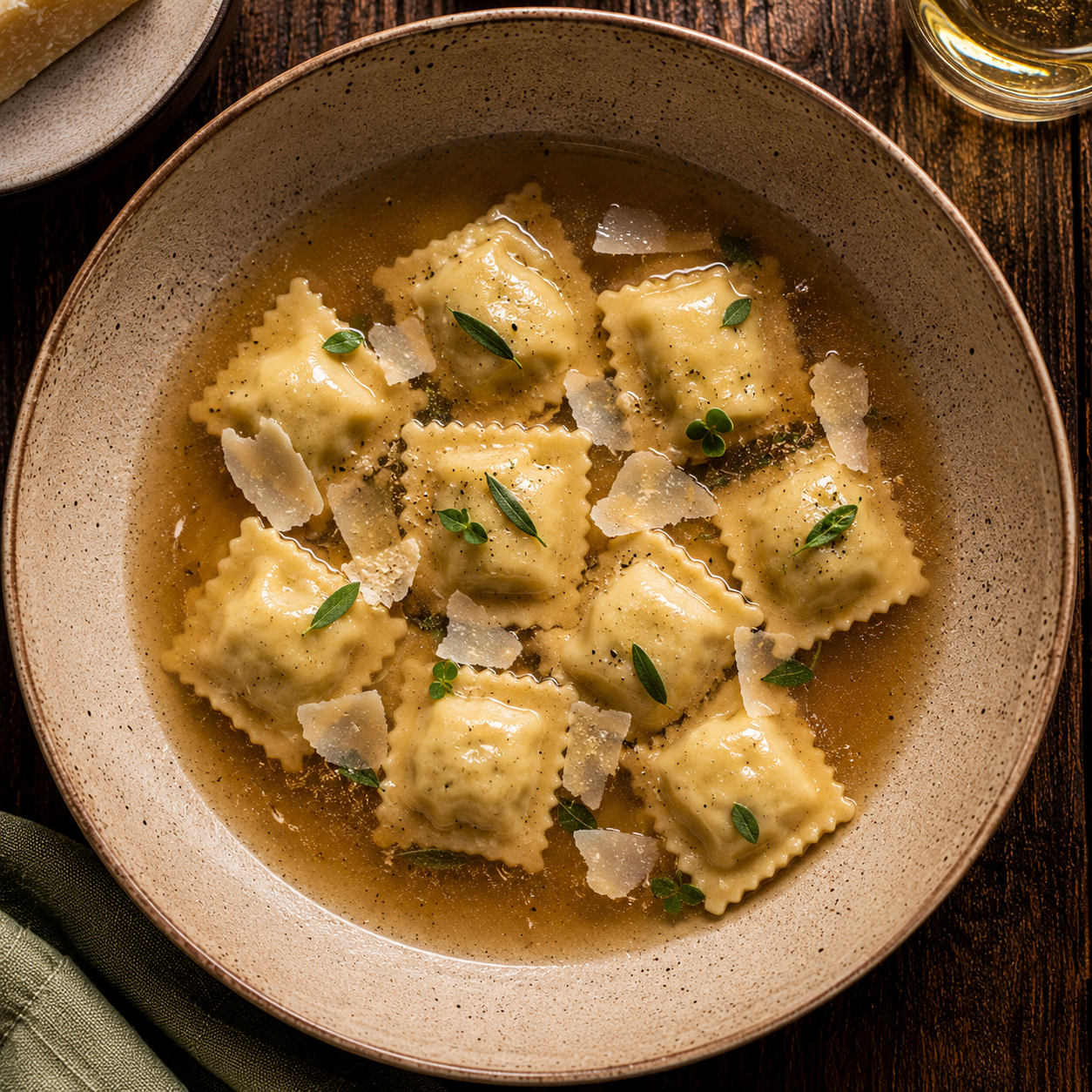
Tiny Piedmontese pasta parcels filled with roasted veal and pork, pinched by hand, then served in a clear Parmigiano broth with brown butter and crisp sage.
240 min
150 min
90 min
4
The Story
Where it comes from
Plin is the sound of the pinch. In the Langhe, Sunday roast never went to waste — it was chopped fine, folded into egg-rich dough, and sealed with a thumb-and-finger squeeze that gave the shape its name. Here the parcels sit in a clear broth drawn from Parmigiano rinds, glossed with sage brown butter: about 70–80 agnolotti, four elegant main portions or six tasting portions.
On the plate
How it should look
Mise en Place
Ingredients
For 4 servings. Quantities are by weight where it matters — Italian cooking is a math of grams and minutes.
For the pasta
- 300 g
Italian "00" flour
- 3
Large eggs
- 2
Egg yolks
- 1 tsp
Extra-virgin olive oil
- pinch
Fine sea salt
- for dusting
Semolina flour
For the sauce
- 225 g
Veal shoulder
cut into 3 cm pieces
- 150 g
Boneless pork shoulder
cut into 3 cm pieces
- 1 tbsp
Extra-virgin olive oil
- to season
Fine sea salt and black pepper
- ½ small
Yellow onion
roughly chopped
- ½
Carrot
roughly chopped
- ½
Celery stalk
roughly chopped
- 1
Garlic clove
lightly crushed
- 1 small
Rosemary sprig
- 2
Sage leaves
- 80 ml
Dry white wine
- 120 ml
Chicken or light veal stock
- 75 g
Baby spinach
- 60 g
Parmigiano Reggiano
finely grated
- 1
Large egg
- ⅛ tsp
Freshly grated nutmeg
- 1 tsp
Lemon zest
finely grated, optional
To finish
- 1 litre
Chicken stock
unsalted or lightly salted — for the broth
- 250 g
Parmigiano Reggiano rinds
scrubbed clean
- ½ small
Onion
sliced
- 1 small
Celery stalk
sliced
- 1
Garlic clove
crushed
- 1
Bay leaf
- 6
Black peppercorns
- 85 g
Unsalted butter
for sage brown butter
- 12
Small sage leaves
- 1 tsp
Fresh lemon juice
- to finish
Finely grated Parmigiano Reggiano
- a few drops
Aged balsamic vinegar
- to finish
Micro sage and black pepper
Equipment
The Method
Chef-led, step by step
- 1
Prepare the Parmigiano broth
75 minCombine the chicken stock, Parmigiano rinds, onion, celery, garlic, bay leaf and peppercorns in a saucepan. Bring just to a gentle simmer — never a hard boil, or the broth turns cloudy and oversalted. Cook uncovered over low heat for 60–75 minutes, rest off the heat 15 minutes, then strain through a fine-mesh sieve lined with cheesecloth. Taste before adding any salt and keep warm without boiling.
Chef's note · Parmigiano rinds season the broth on their own — salt last, if at all.
- 2
Make the pasta dough
45 minMound the "00" flour and make a wide well. Add the eggs, yolks, olive oil and salt, beating with a fork and drawing flour in from the walls. Knead 8–10 minutes until smooth, firm and elastic — slightly firmer than tagliatelle dough. Wrap tightly and rest at room temperature at least 45 minutes.
Chef's note · Chef Rigatoni's test: press with one finger — it should spring back slowly without cracking. Dough, like people, behaves better after a rest.
- 3
Roast the meat
90 minHeat the oven to 165°C/325°F. Season the veal and pork generously and sear in olive oil in batches until deeply browned; don't crowd the pan. Remove the meat, lower the heat, and cook the onion, carrot and celery 6–8 minutes, scraping up the browned bits. Add garlic, rosemary and sage for 30 seconds. Return the meat, add the wine and reduce by half, then add the stock — it should come a third of the way up the meat, not cover it. Cover and roast 75–90 minutes until fork-tender. Strain and reserve the liquid; discard the rosemary stem and garlic but keep the vegetables.
- 4
Prepare the filling
30 minWilt the spinach in a dry pan, cool, squeeze bone-dry and chop finely. Chop the roast meat by hand or pulse briefly — never to a paste. Combine the meat, roasted vegetables, spinach, Parmigiano, egg, nutmeg and optional lemon zest, then add 1–3 tablespoons of the reserved roasting liquid until it just holds together. Season, transfer to a piping bag with a 1 cm opening and chill at least 30 minutes.
- 5
Roll the pasta
Divide the dough into four, keeping the rest covered. Pass one piece through the widest setting, fold into thirds and repeat two or three times, then roll down to about 0.7–0.8 mm — usually the second-thinnest setting. You should see the shadow of your hand through the sheet, yet it should still hold filling. Work on a lightly floured surface and move quickly.
- 6
Shape the agnolotti del plin
Pipe a continuous 1.5 cm line of filling about 2 cm from the long edge. Brush the exposed pasta beside it with water, fold the edge over and press firmly to expel air and seal. Pinch the filled tube every 2.5 cm with thumb and index finger — that pinch is the plin. Trim with a fluted wheel parallel to the filling, then cut between each pinch. Dust a tray with semolina and cover loosely with a towel.
Chef's note · Keep the filling cold and the pasta covered. Warm filling softens dough; dry dough refuses to seal.
- 7
Make the sage brown butter
5 minMelt the butter over medium heat, add the sage leaves and cook 3–5 minutes until the milk solids are golden and smell nutty. Lift out the crisp sage and drain on paper towels. Off the heat, carefully add the lemon juice and keep warm.
- 8
Cook the agnolotti
3 minBring a wide pot of well-salted water to a gentle boil and cook in batches 2–3 minutes — chilled pasta may need another 30 seconds. Move them straight into a wide sauté pan with 2–3 tablespoons sage brown butter, 60 ml Parmigiano broth and a splash of pasta water. Swirl gently 30–45 seconds until glossy, never heavily sauced.
- 9
Plate
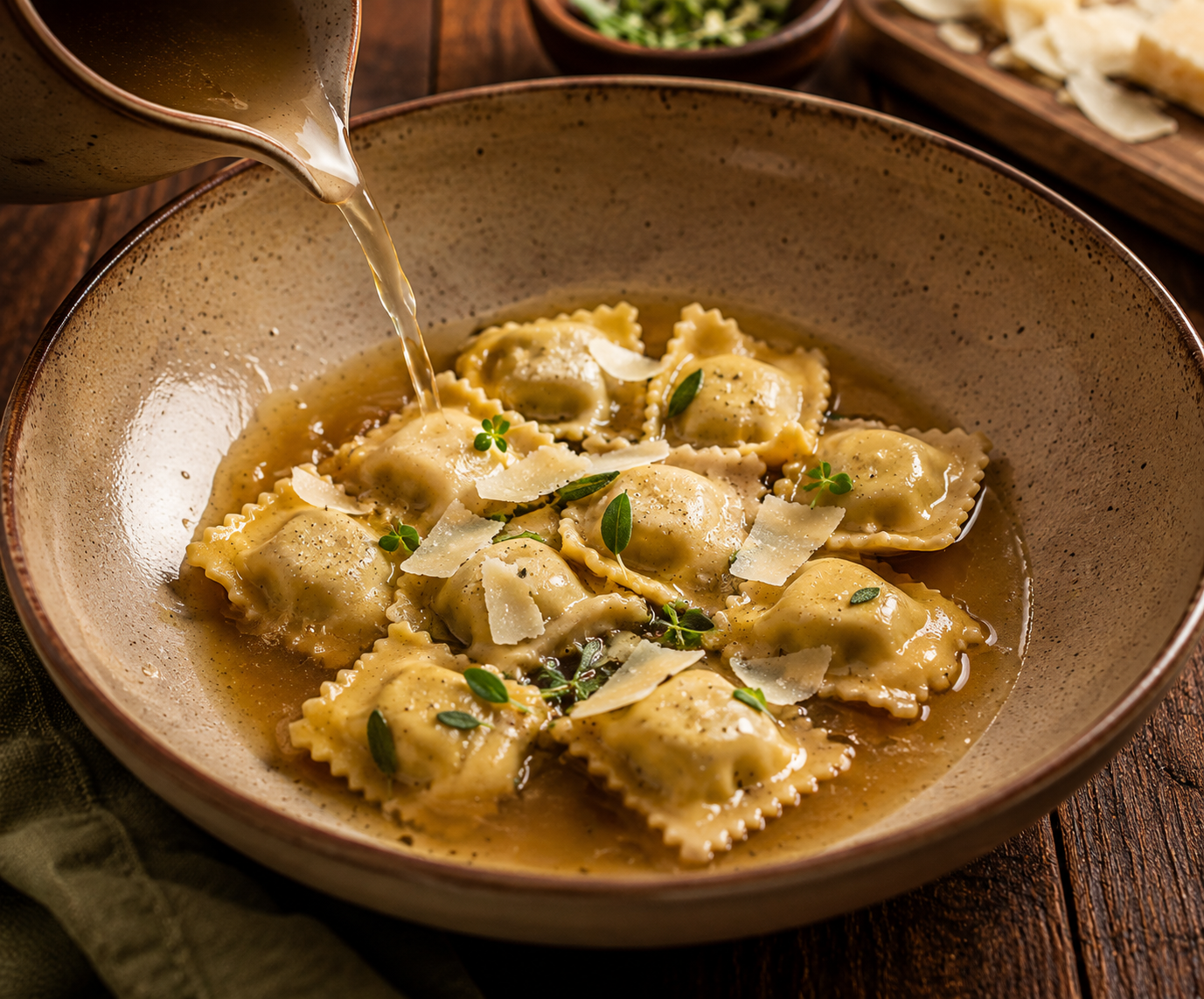
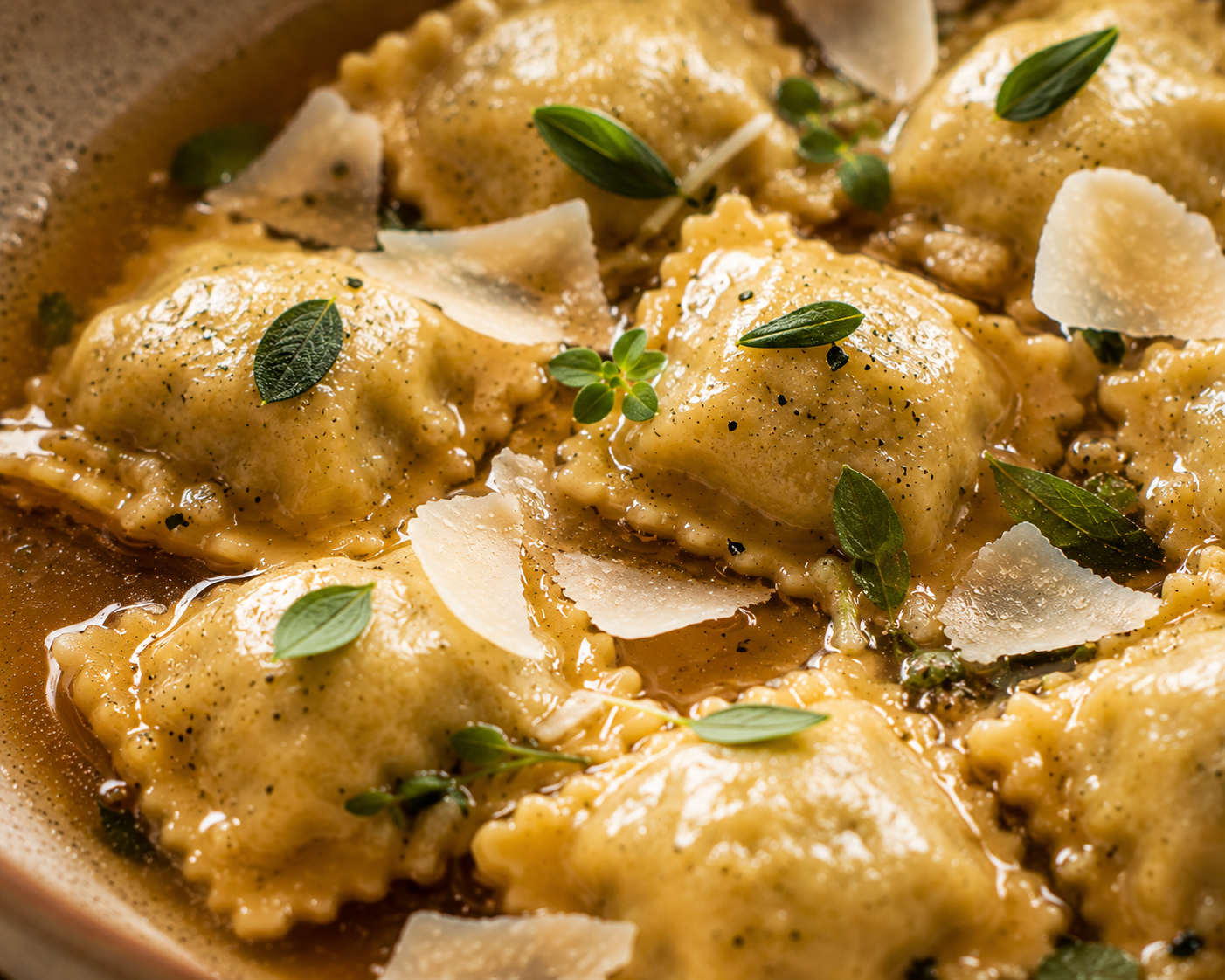
Warm four wide shallow bowls. Arrange 12–15 agnolotti in a loose circle rather than a pile. Spoon 80–100 ml hot Parmigiano broth around — not over — the pasta. Finish each plate with a teaspoon of brown butter, two or three crisp sage leaves, grated Parmigiano, black pepper, three or four tiny drops of aged balsamic and micro sage. Serve immediately.
Chef's note · The broth is part of the picture: keep it clear, the bowl warm and the garnish restrained.
Chef tips
- ·Broth keeps 3 days refrigerated; filling 2 days; shaped agnolotti up to 6 hours on a semolina-dusted tray.
- ·To freeze, freeze uncovered until firm, then bag airtight and cook from frozen for 4–5 minutes.
- ·Brown butter is best made shortly before serving — it loses its perfume standing around.
Common mistakes
- ·Boiling the rind broth hard — it turns cloudy and aggressively salty.
- ·Puréeing the filling into paste instead of chopping it fine.
- ·Drowning the agnolotti in broth so they float rather than sit.
The Cellar
Wine pairings
Roero Arneis
Piemonte
Fresh, almond-scented white that keeps the Parmigiano broth bright.
Langhe Nebbiolo
Piemonte
A lighter Nebbiolo with enough structure for the roasted veal and pork filling.
Shopping List
What to bring home
- Italian "00" flour300 g
- Large eggs3
- Egg yolks2
- Extra-virgin olive oil1 tsp
- Fine sea saltpinch
- Semolina flourfor dusting
- Veal shoulder225 g
- Boneless pork shoulder150 g
- Extra-virgin olive oil1 tbsp
- Fine sea salt and black pepperto season
- Yellow onion½ small
- Carrot½
- Celery stalk½
- Garlic clove1
- Rosemary sprig1 small
- Sage leaves2
- Dry white wine80 ml
- Chicken or light veal stock120 ml
- Baby spinach75 g
- Parmigiano Reggiano60 g
- Large egg1
- Freshly grated nutmeg⅛ tsp
- Lemon zest1 tsp
- Chicken stock1 litre
- Parmigiano Reggiano rinds250 g
- Onion½ small
- Celery stalk1 small
- Garlic clove1
- Bay leaf1
- Black peppercorns6
- Unsalted butter85 g
- Small sage leaves12
- Fresh lemon juice1 tsp
- Finely grated Parmigiano Reggianoto finish
- Aged balsamic vinegara few drops
- Micro sage and black pepperto finish
Questions