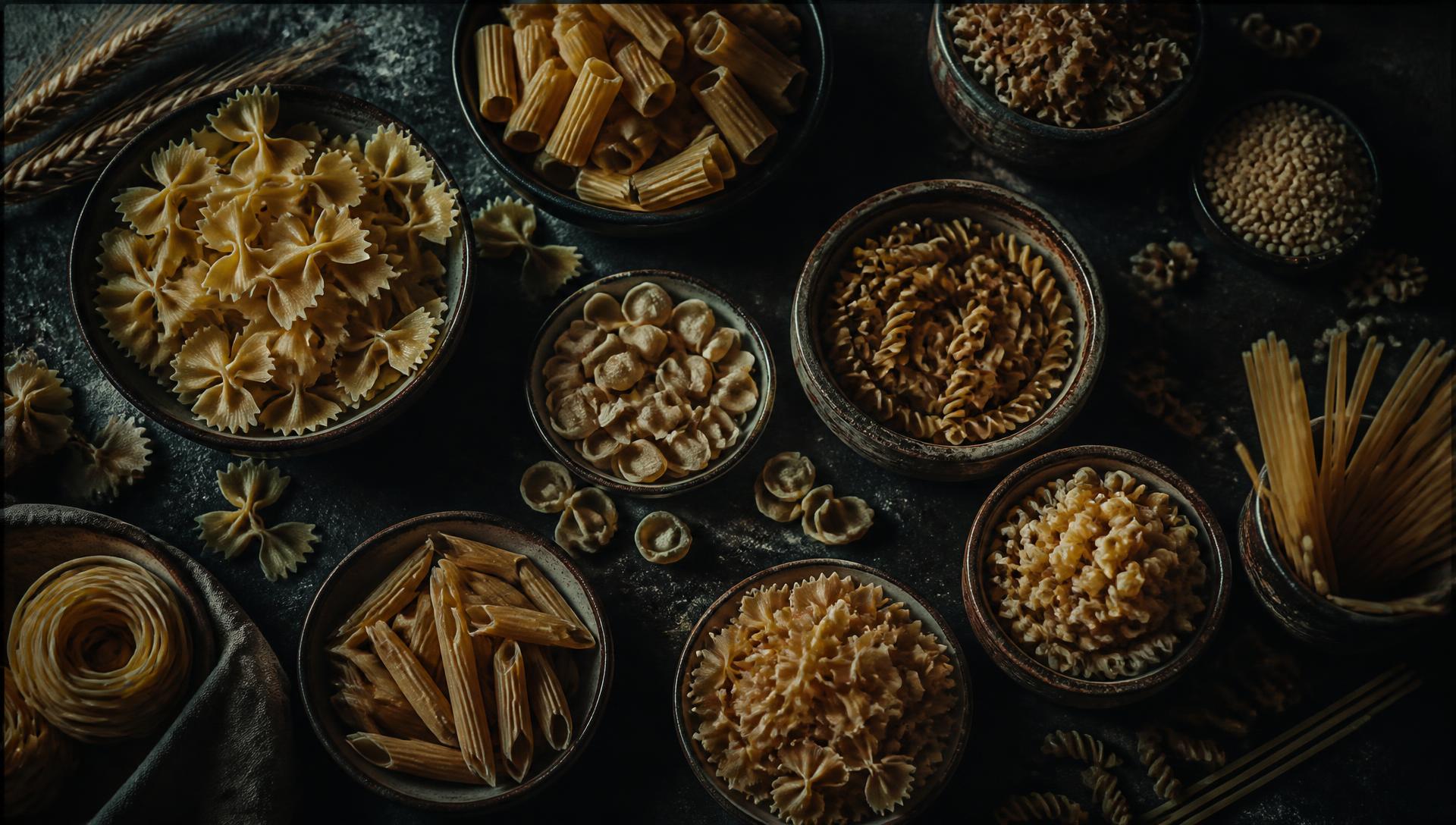
Italians did not invent 71+ shapes for decoration. Every ridge, hollow and twist is an engineering decision about how much sauce reaches your palate per bite. Shape first, sauce second — that is the whole grammar of Italian cooking, and this page is the dictionary.
71 shapes across 8 families, with pronunciation, home region, the sauce each one was built for, and the recipes to cook them in.
How to choose a shape
There is one rule underneath all the others: the sauce has to be able to hold on. Use this as your cheat sheet.
If the sauce is…
Reach for…
Why
Thin, oily sauces
Long strands
Oil coats a smooth strand evenly; there is nothing to trap, so nothing is lost.
Rich meat ragù
Egg ribbons and wide tubes
Fat needs surface area. Wide flat noodles and big ridged tubes give the sauce somewhere to sit.
Chunky vegetable sauces
Short sculpted shapes
Curls, ears and shells scoop up peas, beans and diced vegetables instead of letting them fall.
Pesto and crumb dressings
Trofie, casarecce, busiate
Rough, grooved surfaces hold thick uncooked pastes that would slide straight off a smooth strand.
Soups and legumes
Pastina and tiny tubes
Small shapes fit on a spoon and release starch into the broth, thickening the whole bowl.
Baked dishes
Sheets, rigatoni, paccheri
They keep structure through 40 minutes in the oven and absorb sauce without collapsing.
Delicate fillings
Stuffed pasta
Butter, sage or broth only — the filling is already the sauce.
Pasta lunga
Long strands
Round or oval strands extruded through bronze dies. They twirl, they slip, and they live or die by how well a sauce clings to their surface.
Pair with oil-, egg- or seafood-based sauces that coat rather than cling.
Spaghetti
Nationwide
Spaghetti
spa-GHET-tee · “little strings”
The default Italian noodle: a round strand about 2 mm thick, usually cooked in 8 to 10 minutes. Bronze-die versions have a chalky, sauce-grabbing surface.
Built for
Carbonara, aglio e olio, clams, simple tomato
Chef's note
Finish it in the pan with a ladle of pasta water — that's where the sauce is made.
Flat sheets cut into strips, almost always enriched with egg. The wide surface is a landing pad for fat, so they belong with butter, cream and slow-cooked meat.
Pair with rich meat ragù, butter sauces and anything with body.
Tagliatelle
Emilia-Romagna
Tagliatelle
tal-ya-TEL-leh · “from 'tagliare', to cut”
Egg ribbons about 7 mm wide — the official partner of Bolognese ragù, with the width registered in a Bologna chamber of commerce.
Built for
Ragù alla bolognese, mushroom, prosciutto and cream
Chef's note
Fresh tagliatelle needs only 2 to 3 minutes. Watch it, don't time it.
What is the difference between penne and rigatoni?
Penne are cut on an angle into quill-like points and are narrower; rigatoni are wider, cut straight across, and always ridged. Rigatoni's larger opening makes it better for chunky meat and offal sauces, while penne suits smoother tomato and cream sauces.
Which pasta shape should I use for carbonara?
Spaghetti is the Roman standard, with rigatoni a very common alternative in Rome itself. Both give the egg-and-pecorino emulsion enough surface to cling to. Avoid delicate shapes such as angel hair, which the sauce overwhelms.
Is orzo pasta or rice?
Orzo is pasta. It is made from durum wheat semolina and simply shaped like a large grain of rice. In Italy it is sold as risoni; the word orzo actually means barley, which is a separate grain entirely.
What does 'rigate' mean on a pasta packet?
Rigate means ridged, and lisce means smooth. Ridges dramatically increase the surface area a sauce can hold, so choose rigate for thin or watery sauces and lisce only for very rich, oily ones that already coat well.
How many types of pasta are there?
Estimates run from about 350 recognised shapes to well over 600 once regional and dialect names are counted, because the same shape often carries a different name in every valley. This encyclopedia covers the shapes you will actually meet on a menu or in a shop.
Does the pasta shape really change the taste?
It changes how the dish eats, which amounts to the same thing. Thickness controls chew, surface texture controls how much sauce reaches your palate per bite, and hollows decide whether the sauce arrives with the pasta or slides to the bottom of the bowl.